
DAM Software for Scientific Visual Libraries: What Pharma and Biotech Teams Should Look For
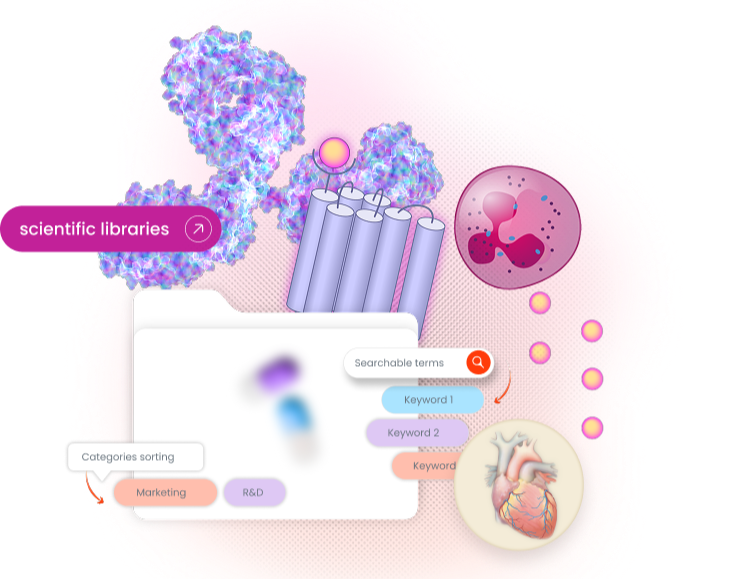
Scientific visual library: virtual folders organized by department holding specific content.
A DAM can help pharma and biotech teams store, tag, and manage scientific visuals, but DAM software alone does not create a scientific visual library. A scientific visual library also needs approved visuals, source files, review context, reusable components, and a shared visual lexicon.
What is DAM software?
DAM stands for digital asset management.
DAM software helps teams store, organize, tag, search, share, and manage files such as images, videos, PDFs, design files, presentations, brand assets, and campaign materials.
For pharma, biotech, medtech, and Medical Affairs teams, a DAM can be useful because scientific visuals often live across too many places: shared drives, old PowerPoint decks, agency folders, local desktops, emails, websites, training modules, and congress materials.
A DAM can bring those files into one searchable home.
But that does not automatically make the visuals reusable, think about it.
What is the difference between a DAM and a scientific visual library?
The definition of DAM is “Digital Assets Management”, it is a structure in place to manages files. A DAM can tell a team where an image is stored, what format it is in, when it was uploaded, who can access it, and which metadata is attached to it.
On the other side, a scientific visual library gives files scientific meaning. And as such, a scientific visual library or scientific visual lexicon should also answer questions like:
What does this visual explain?
Which scientific decision does it preserve?
Who reviewed it?
Is it approved?
Which audience is it for?
Is it Medical Affairs, commercial, patient-facing, investor-facing, or internal?
Can it be adapted?
Where is the editable source file?
What should stay visually consistent?
Which molecule, pathway, disease state, anatomy, or mechanism does it belong to?
Is this still scientifically current?
That is the difference.
A DAM can host the library. But the DAM is not the library itself.
💊 🧬 Why pharma and biotech teams search for DAM software
Because it is generally used by marketing teams, often start searching for DAM software when the file problem becomes visible. These teams are used to deal with huge amount of files and different communication purposes.
Common search moments include:
approved visuals are hard to find
teams keep reusing old slides
people are unsure which version is final
agencies keep asking for source files
Medical Affairs needs non-promotional versions
commercial teams need adapted versions
scientific illustrations are spread across projects
congress, training, web, and patient materials all need the same science
the company has no clear system for visual reuse
At that stage, a DAM feels like the obvious solution.
Sometimes it is part of the solution. But before choosing the tool, the team should clarify what the visual system actually needs to preserve.
What scientific visuals need that generic DAMs do not solve alone
Scientific visuals are not ordinary brand assets. A logo, campaign photo, or brochure image needs metadata such as file name, campaign, usage rights, and format. But when it comes to scientific visuals, well these often needs more context.
Source files
Final PNGs and PDFs are often not enough. Reuse depends on multiple versions that guarantee vicinity with the original source files in the form of structured component files.
Audience and use case
The same illustrated mechanism of action may be produced as version for investors, but it can as well be used in different settings, once finalized. Another use of it could be for the company Medical Affairs team, another for patient education, and another for internal training. So, it is essential that we can provide a label mentioning all these uses.
Medical vs commercial use
Medical Affairs visuals may need a different tone, claim structure, or review pathway from commercial visuals.
Visual language
A DAM can store icons and illustrations. A scientific visual lexicon defines how those icons and illustrations should be used consistently.
Reusable components
A scientific brand visual library should not only store finished images. It should also preserve reusable components: molecules, cells, organs, pathways, icons, labels, callouts, and diagrams.
Major DAM software providers
The DAM market includes many providers. The best choice depends on company size, internal workflow, integrations, budget, compliance requirements, and how the team already manages content.
Current DAM software providers include:
Acquia DAM (formerly Widen)
Sitecore Digital Asset Management (part of Sitecore Content Hub)
This list is not a ranking. For scientific visuals, the more important question is not only “Which DAM is best?” but “What scientific visual system will the DAM need to support?”.
It turns out every company has a different way of ideating, working on, and storing custom made scientific visuals, so we made sure to build a system that is flexible enough to allow them customization and a streamlined production system. You can find it here
How to choose DAM software when developing scientific visuals
When choosing DAM software for a scientific visual library, pharma and biotech teams should look beyond general storage features, and useful questions include:
Can metadata reflect scientific meaning?
You may need tags for mechanism, molecule, pathway, disease area, asset type, audience, review status, indication, program, and approved use. The DAM needs to be reflecting scientific meaning well, seek to find a tool that offers this flexibility
Can teams control access by audience or function?
Medical Affairs, commercial, agencies, leadership, and external partners may need different levels of access.
Can the DAM support version control?
Scientific visuals change as the science evolves. Version history matters a lot in the case of a ever evolving scientific research.
Can review status be visible?
Your visual library should make it easy to know whether an asset is draft, reviewed, approved, retired, or needs update.
Can the DAM connect to existing workflows?
The system should fit the way teams already work across PowerPoint, design tools, websites, learning platforms, and agency collaboration.
Does the system support reuse, instead of just storage?
The most important question is whether the DAM helps people find the right visual, understand how to use it, and adapt it safely.
What to build before choosing the DAM
Before choosing DAM software, a team should audit the visual assets and define the structure of the scientific visual library.
A useful starting point:
List the recurring scientific stories.
Identify visuals that already exist.
Separate final images from editable source files.
Mark what is approved, outdated, duplicated, or missing.
Define the main asset categories: MOA, disease pathway, anatomy, molecule, cell, patient education, training, icons, data visuals.
Decide what metadata matters.
Define the scientific visual lexicon: how key concepts should be represented consistently.
Decide what needs to be rebuilt, adapted, or retired.
This makes the DAM decision much clearer.
Instead of asking, “Where should we store files?” your team can ask, “What kind of scientific visual system are we trying to create, so that reuse feels a seamless task?”
The best setup is often not one or the other.
It is a scientific visual library and lexicon, hosted or supported by the right DAM.
FAQs
What is the best DAM software for pharma?
There is no single best DAM software for every pharma team. The right DAM depends on company size, compliance needs, integrations, review workflows, access control, metadata structure, and the type of assets being managed.
What is the best DAM software for biotech?
For biotech teams, the best DAM is usually the one that can support scientific visuals, source files, version control, metadata, and cross-functional reuse without becoming too heavy for the team to maintain.
What is the best DAM software for medical device companies?
For medical device companies, the best DAM is the one that supports regulated work (audit trails, approvals, role-based permissions, and clear version history), keeps technical context with each asset (product version, IFU and labeling alignment, intended use, region, and lifecycle status), handles the file types device teams actually use (CAD exports, high-resolution images, video, brochures, clinical evidence PDFs, and training decks), makes reuse safe (so the latest approved version is easy to find and anything superseded is clearly marked), and fits the tools teams already work in (Microsoft 365 or SharePoint, Adobe, CRM, LMS, and agency collaboration).
In practice, that usually means choosing a DAM that is strong on governance and metadata, then designing a device-specific taxonomy (device family, indication/intended use, claims, region, lifecycle status, and supporting evidence) so the DAM can act like a trusted system, not just storage.
Can a DAM manage scientific visuals?
Generally yes, but with some restrictions. A DAM can manage scientific visuals if the metadata, folder structure, access rules, and versioning are designed around scientific use cases. But the DAM alone does not create the scientific visual library or lexicon.
Is a DAM the same as a scientific visual library?
No. A DAM stores and manages files. A scientific visual library organizes approved scientific visuals, source files, review context, reusable components, and visual meaning so teams can trust and reuse them.
What is the difference between a DAM and a scientific visual lexicon?
A DAM is a software system for managing assets. A scientific visual lexicon is the shared visual language used to represent scientific concepts consistently, this needs to be created by expert scientific or medical illustrators.
What metadata should scientific visuals include?
Scientific visuals may need metadata for asset type, mechanism, molecule, pathway, disease area, program, audience, review status, approved use, source file, version, date, owner, and reuse notes.
Should Medical Affairs use a DAM?
Medical Affairs can benefit from a DAM when teams need to find, manage, and reuse approved non-promotional scientific visuals. But the assets also need clear scientific context and review status.
Can DAM software store medical illustrations and source files?
Many DAM systems can store medical illustrations and source files, but teams should confirm file compatibility, preview support, versioning, permissions, and source file retrieval before choosing a system.
Do pharma companies need a DAM or a scientific visual library?
Often, they need both. The DAM provides the technical home. The scientific visual library provides the structure, context, and reusable visual system.
What should be organized before choosing DAM software?
Before choosing DAM software, organize the recurring scientific stories, asset types, source files, approval status, metadata needs, audience variants, and visual language rules.
Final thought
A DAM can be an important part of a scientific visual system.
But it is not the system by itself.
For pharma, biotech, medtech, and Medical Affairs teams, the real value comes from preserving the scientific judgement behind the visuals: what they mean, how they were reviewed, how they can be adapted, and how they should be reused.
That is what turns stored files into a scientific visual library.
What is the first step for building a scientific visual library?
The Best thing you can do today to understand if you need a library or you're fine is to have a visual audit done: to first review what exists, select what is accurate, refine what is approved, decide what can be reused, and identify what needs to be rebuilt.
At Visualmedics, we develop scientific brand visual libraries with the same principles and more flexibility than a DAM. Check it out here